By Kayla Kuhn, Micaela DePauli, Kiser Davis, Liz Pritchard
—Albuquerque, NM
The Paid Family and Medical Leave Act (PFMLA), a long-debated topic in New Mexico, is set to return in the 2025 legislative session. Originally introduced in 2019, the bill has faced considerable political and economic scrutiny. ( Senate Bill 3 )
The PFMLA proposes a state-administered program through the Department of Workforce Solutions (DWFS), offering 9-12 weeks of annual paid leave for qualifying family or medical reasons. Businesses with under five employees would be able to opt out.
New Mexico currently complies with regulations of the Federal Medical Leave Act. There is no PFML in New Mexico, meaning if a New Mexican employee must take medical leave for themselves or a loved one, they do so unpaid.
The Federal Family and Medical Leave Act was passed in 1993. According to a report published by the DWFS, about 4% of companies in New Mexico are subject to the FMLA. To qualify, a company must have at least 50 employees for 20 weeks out of the year. The FMLA offers 12 weeks of unpaid leave annually.
Additions to FML implemented by New Mexico include safeguards for domestic and sexual abuse and violence. All employers in New Mexico are required to provide 14 days of incremental paid or unpaid leave if an employee needs time-off to obtain judicial relief or protection from abuse for themselves or a family member.
Governor Lujan Grisham signed an executive order in 2019 giving all state employees 12 weeks of paid parental leave. The employees must have worked for at least a year and be full-time.
In April 2021, New Mexico enacted the Healthy Workplaces Act requiring private companies to provide paid sick leave. Under the HWA, one hour of paid sick leave is accrued for every 30 hours worked. Employees may use up to 64 hours of earned sick leave a year.
In the 2024 New Mexico legislative session, a bill that would have guaranteed PMFL for New Mexico workers was narrowly defeated in the House with a 34-36 vote after passing in the Senate 25-15.
It was sponsored by Democratic Senator Mimi Stewart (Bernalillo), and Democratic Representatives Christine Chandler (Los Alamos), Linda Serrato (Santa Fe), and Patricia Roybal Caballero (Bernalillo) all four of whom were reelected in the 2024 general election.
In the League of Women Voters Guide, Rep. Roybal Caballero wrote her top priority is PFML. “I intend to build on the years of coalition work and strengthen relationships to see these to the finish line and into law in 2025.”
One Democratic Senator, George Muñoz of Gallup opposed the bill; he won his bid for reelection this year. Eleven Democratic House members joined Republicans and opposed the bill, six of whom were reelected this November: Cynthia Borrego (Bernalillo), Wonda Johnson (Rehoboth), Raymundo Lara (Chamberino), Lundstrom (Gallup), Joseph Sanchez (Alcade), and Marian Matthews (Albuquerque).
New Mexico’s proposal aligns with similar laws in 13 states; California, New Jersey, Rhode Island, New York, Washington, Massachusetts, Connecticut, Oregon, Colorado, Maryland, Delaware, Minnesota, Maine, and Kentucky and Washington D.C.
Under the proposal, eligibility for PFML would require employees to contribute to the fund for at least six months and give at least 20 days notice for non-emergency situations.
Qualifying events for PFML include managing one’s physical or mental health, caring for a family member, welcoming a new child, adopting or grieving a child, handling legal, psychiatric and/or medical issues from domestic abuse or sexual assault, or preparing for active-duty deployment. The leave can be taken incrementally, but at least eight hours at a time.
Compensation would be administered from a state fund as a percentage of an employee’s average income. The fund would be supported by employee and employer contributions. To protect the fund’s solvency, the contribution tax would commence one year before benefits are dispensed. Contributions would start a year after the passing of the law, giving business owners time to prepare.
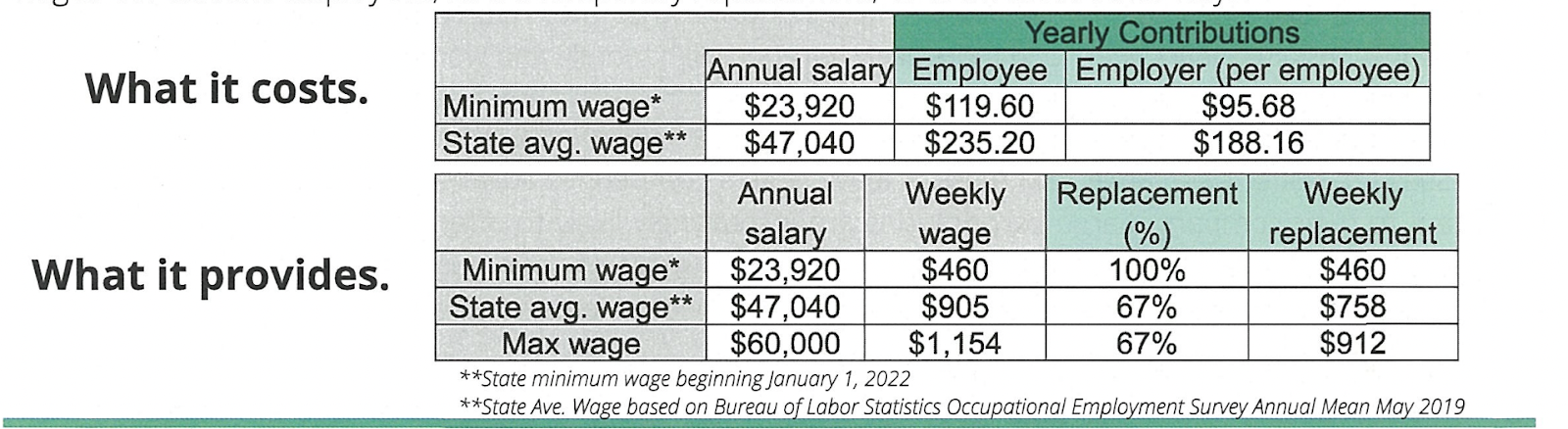
The contributions would depend on income, but roughly come out to:
Employees: $5 per $1000 earned
Employers: $4 per $1000 earned
Employers with fewer than five employees, who opt in: $0
Their employees: $5 per $1000.
Below is a breakdown of the costs an average New Mexican worker can expect to pay in contribution taxes provided by the Southwest Women’s Law Center.
The Human Impact
The Paid Family Medical Leave Act being implemented in the state would drastically change the way parents can balance the important aspects of their lives. Managing work and family is never an easy task and can affect one’s ability to tend to their workplace or provide care for their family. For families like Tonia Kuhn’s, PFML is more than a policy, it’s a lifeline.
“It’s a constant balancing act,” Tonia shared. “There were times I had to choose between being at the hospital with my daughter and keeping my job. PFML helped, but only to a point.”
Tonia, a manager at Dillard’s in Albuquerque, knows firsthand the struggles that come with navigating PFML while caring for a child with complex medical needs. Her daughter, born with Spina Bifida and Scoliosis, requires ongoing medical attention and specialized care. While Dillard’s version of PFML benefits offer some level of job security, Tonia’s experience reveals significant gaps that leave many families struggling with difficult choices that they are forced to make.
Tonia explained that while she was able to take time off under Dillard’s PFML, the financial strain was immense because, at the time, Tonia was only entitled to 67% of her salary. “You’re not just worried about medical bills and caregiving costs. You’re also losing part of your income,” she said. Tonia further explained how she “ended up dipping into savings to make ends meet, and not everyone has that option.”
Her story underscores the common challenge with PFML, while it provides job protection to an extent, it often fails to provide adequate financial support. This forces many working families to make heartbreaking decisions, particularly those in sectors such as retail like Tonia, where options are less beneficial. The troubles Tonia faces as a retail worker resonate with healthcare workers as well, due to the absence of extensive PFML policies.
Courtney Beach, a head charge nurse at the University of New Mexico Hospital (UNMH), shares her perspective on how the current system impacts nurses and their families. “Both I and about half of my full-time colleagues have used UNM’s version of PFML either this or last year,” Courtney said. She goes into further detail explaining that in order “to be paid during that time, we’re required to use our accrued sick and vacation hours until they’re gone. If those run out, you’re left without an income, even though your job is technically protected.”
Courtney believes that along with PFML, the complicated application process can be another barrier for employees. In order to receive assistance, “you must have worked full-time for at least a year, and the paperwork is daunting,” Courtney said. “It has to be renewed annually, and healthcare providers often charge extra to fill out the forms. For part-time workers or those new to a job, it’s nearly impossible to qualify.”
Both Tonia and Courtney have felt the effects of inadequate PFML policies. For new mothers, the financial strain can force them back to work sooner than they’re ready. “I’ve seen many new moms use up their sick and vacation hours and be forced to return to work because they can’t afford unpaid leave,” Courtney explained. The consequences extend beyond individual families. Within healthcare, Courtney pointed out that the lack of PFML also contributes to staffing shortages along with low morale. “Many employers hire part-time workers so they don’t have to provide benefits like Family Medical Leave,” she said. “This leaves workers juggling multiple jobs, exhausted and frustrated, which impacts their performance and, ultimately, patient care.”
In Tonia’s case, it’s about giving families the financial and emotional support they need during critical times. “Parents like me shouldn’t have to choose between their child’s well-being and a paycheck,” she said. Courtney, on the other hand, advocates for federal reforms to make PFML more accessible and equitable. “FMLA is outdated,” she said. “The federal government should fund wages during leave, and the process to qualify needs to be simplified. All employees, regardless of job type or hours worked, should have access to paid leave.”
With the bill returning to the table for the 2025 legislative session, working mother Keymonie Allen is also ready to see it pass. “Sometimes it feels like I’m having to choose between my job, my kids, my personal life, or my health.” Allen has three kids and says she often feels torn being a working mom. “I never want to pull back from work, but if I need to care for them, then my priority has to be my kids.”
Keymonie Allen and her husband were planning for their second child at the time PFML was first introduced and say they had many fears surrounding their finances.
“There were times that my husband had to take time off for our kid because I couldn’t and if we had paid leave for both of us, we could’ve shared those responsibilities which is what we wanted to do,” Allen shares she believes this legislation would only create healthier family dynamics. “Parenting is about teamwork and if we want people to be good parents to their children, then we need to have access to be able to show up when we need to.”
Policies like the PFMLA would impact how parents can appropriately manage hard situations. Allen says passing this legislation previously would’ve changed everything when it came to having her children, one of them born earlier this year.
“It would have helped me during all three of my pregnancies. The stress of having to take unpaid leave is real and it causes more stress when you’re already trying to keep everything else running,” Allen says. “It would’ve been nice to take more time for maternity leave, to focus on my health, but there was a lot of worry of whether we were going to make ends meet or not.” Allen revealed she couldn’t afford to take too much time off as she and her husband were prepping for baby number three.
This kind of emotional struggle is something that takes its toll on many working parents. With the Paid Family Medical Leave Act potentially being signed into legislation, parents, guardians and families of all kinds could take some of the pressure off and be allowed to prioritize their care and their families without feeling guilt.
Focus on Marginalized Communities
There is still heavy momentum towards pushing for statewide PFML, especially while the cost of living continues to increase and not being paid for an extended period of time becomes less and less accessible to the average worker.
The FMLA does protect medical coverage very broadly but with the national political climate swinging towards conservatism, there is a sense of pressure to protect the rights of vulnerable communities. One aspect to consider is the role of FML when it comes to gender-affirming care.
While interviewing trans students at the University of New Mexico about their perspective on PMFL and what it could do for themselves and the trans community, one student Noe Fields-Perkins said he supports implementing it in New Mexico and thinks it would be very beneficial for trans individuals.
He elaborated on experiences with people he knew personally who have dealt with physical side effects ranging from scars not healing to surgical complications. These issues stem from not having enough time away from work to heal after gender-affirming surgeries.
Another UNM student, Mack Burnett, said it is crucial because for many individuals it is a matter of scarcity. “A lot of people only have a certain period of time in which they can get a surgery like that, and it’s not easy to get to the point where you can.”
A hot-button issue in the 2024 national election was transgender individuals and their existence in the current American political climate. With many speculating Project 2025 becoming a reality come January, there are many ways that this will affect gender-affirming care.
According to Marshall Martinez via a New Mexico Political Report interview, there are plans for a National Institute of Health study focusing on the negative effects of gender-affirming care, with Martinez noting, “The proof is that the mandate is starting from a place of confirmation bias. It is instructing a federal agency to assume that gender-affirming healthcare is harmful and they must prove how and why.”
Martinez also said that another aspect of Project 2025 that looks to have long-term negative impact on the trans community are the cuts to Medicaid. This is impactful because most transgender individuals in the Albuquerque metro receive their gender-affirming care from the University of New Mexico.
Burnett shared his perspective about the possibility of not having access to gender-affirming care saying, “It’s like you’re taking away a piece of somebody.”
Field-Perkins also talked about how restricting access to safe and affordable gender-affirming care would not stop people from seeking it, but instead would force them to seek it in unsafe ways. “In places where it is illegal to get gender-affirming care, and when it was completely illegal in the US, people still got top surgery and people still got testosterone. They were just getting it in illegal, unsafe, and unregulated ways.”
Since this is such a crucial part of healthcare for the trans community, it is fair to ask the question whether the legislative session will include protections for these rights and medical services through either civil protections or alternate funding mechanisms. Looking towards the possibility of having access to PMFL, it is important to trans community members that their medical needs are also covered and protected. Especially with national pressure to encroach on those necessities.
Field-Perkins noted that access and affordability are crucial for trans individuals, and could be a matter of life and death. He talked about how female to male individuals who have full bottom surgery no longer naturally produce sex hormones. “They’re completely reliant on the hormones they’re injecting, so if they don’t have that they will die… It’s a fact that many people, if they stay in the US and don’t have access to testosterone, will die.”
It’s important to see if these issues are addressed by state representatives in the upcoming legislative session as there are many facing the trans community in trying to maintain gender-affirming care and having it covered by PMFL.
Arguments For PFML
Economic Security: New Mexico has higher poverty rates than most states; PMFL is an investment for a safety net that will help people get out of “survival mode.” It also reduces the need to choose between health and financial stability.
.
Workforce Stability: PFML gives small businesses a competitive advantage in retaining and recruiting talent and allows them to compete with corporations that offer private paid leave programs. It gives employers a chance to be prepared for life’s inevitabilities and prevent the high costs of turnover and employees infecting one another with illnesses.
When people can take care of medical problems before they’re dire, they will have more control over their situation and will be less likely to have to quit. If employers invest in preventative expenses to preserve a stable workforce, it shows employees they have a safe work culture that makes them feel cared for and protected.
Social and Broader Participation Benefits: PMFL gives women leverage in family planning, it helps victims escape dangerous abuse, and single parents manage life with more ease. Fewer children would go through traumatic medical procedures alone, like chemotherapy and being airlifted to a hospital.
The law would empower more people to enter the workforce. Unemployment would decline, allowing more women, differently abled and chronically ill people, individuals who need gender-affirming care, and rural residents who must travel long distances for healthcare to join.
According to polls conducted by Dr. Gabriel Sanchez, a UNM professor of political science, most of the public want to see the expansion of PFML. He added, “All the data I’ve ever collected in my career says even the majority of New Mexicans would be willing to pay a little bit more into the system to see it expanded.”
Arguments Against PFML
Economic Burden: Business owners say they’d have to fire employees due to the potential strain from the tax. Or could potentially go out of business.
Post Covid Concerns: Businesses want time to recover from changes in paid sick leave (HWA) and minimum wage laws.
Partisan Divide: The bill has not gained Republican support and garnered 50,00 online petition signatures in opposition.
Program Scope: Some Republican lawmakers support the idea but say the 12-week period is excessive and the overall language of this bill is too broad.
Terri Cole, president of Greater Albuquerque Chamber of Commerce, said, “There is not a single business organization that I am aware of who supports this bill.”
Looking Ahead to 2025
Experts are divided on the PFMLA’s prospects in the upcoming session.
Dr. Sanchez said because there are many uncertainties about the Trump Administration’s stance on PFML, there may be little incentive and pressure to pass the bill this year. There’s a good chance legislators won’t know the status of federal funding by the time of the session, so that could be a reason legislators will postpone action to next year.
However, Sanchez noted Vice President-elect J.D. Vance has spoken highly in favor of PFML. “So, there’s some optimism that there might still be some federal funding available to do this. But I didn’t hear anything from Trump directly on this.”
A source close to the Senate predicts the opposite: that senators will feel the pressure to safeguard New Mexicans in the absence of clear federal support.
The debate underscores a critical question: Can New Mexico balance the economic needs of businesses with the well-being of its workforce?
The PFML program would require a $36 million upfront investment repaid incrementally by 2033. Paid leave would begin by 2028.
Liz Pritchard is a student at the University of New Mexico. Follow her journalism at lightfromalamp.com.


Leave a comment